
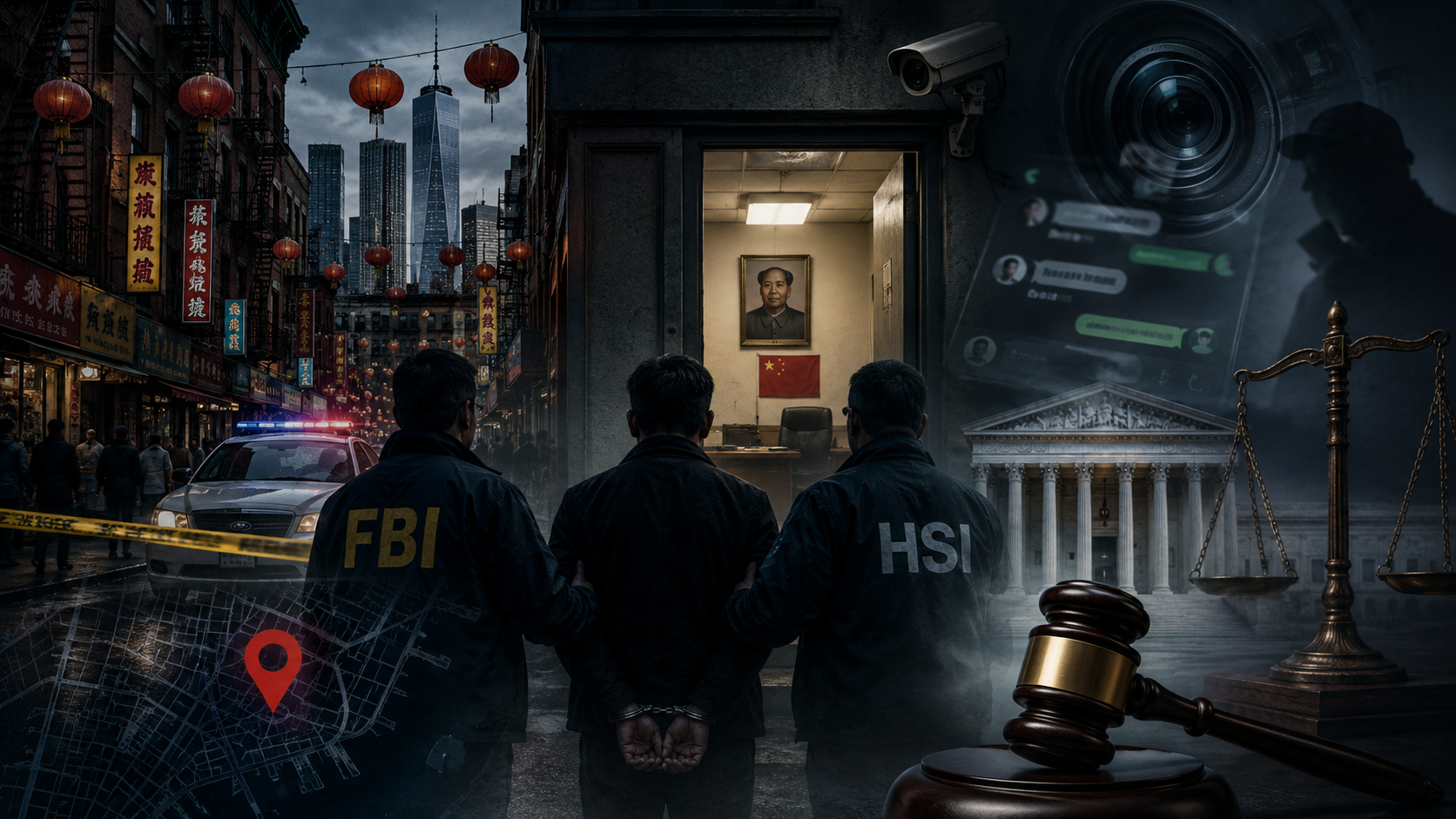
A federal jury in Brooklyn has convicted Lu Jianwang, a 64-year-old U.S. citizen also known as Harry Lu, for his role in operating what prosecutors described as a secret Chinese police station in Manhattan’s Chinatown.
The verdict, delivered on May 13, 2026, found Lu guilty of acting as an unauthorized agent of a foreign government and obstruction of justice. Prosecutors said Lu deleted text messages with a handler tied to China’s Ministry of Public Security after the FBI began investigating the operation. He was acquitted on a separate conspiracy charge.
The outpost was allegedly known as the “Fuzhou Police Overseas Service Station” and began operating in early 2022. On the surface, the defense argued, the location helped Chinese Americans with ordinary administrative tasks such as driver’s license renewals and community activities. Prosecutors, however, painted a very different picture.
According to the government, the station was not simply a neighborhood assistance office. Federal prosecutors said it operated on behalf of the Chinese government and was used to monitor, identify, and pressure political dissidents living in the United States. One person allegedly targeted was pro-democracy activist Xu Jie.
The case became one of the most visible examples of what U.S. officials call transnational repression — foreign governments attempting to intimidate, surveil, or control critics beyond their own borders.
Lu’s co-defendant, Chen Jinping, pleaded guilty in December 2024 to conspiring to act as an agent of the Chinese government in connection with the same alleged station. Chen is still awaiting sentencing.
The Chinese government has denied accusations that these overseas stations are part of a repression network, claiming they are volunteer-run centers meant to help Chinese citizens abroad with routine paperwork. But U.S. officials and rights groups have argued that such sites can serve a much darker purpose: extending the reach of China’s security apparatus into foreign countries.
Lu now faces up to 30 years in prison. He remains free on bail while awaiting sentencing.
This conviction is significant because it shows how seriously U.S. authorities are treating foreign influence operations carried out on American soil. The case is not just about one office in Chinatown. It is about the larger question of whether foreign governments can operate unofficial law enforcement networks inside the United States without accountability.
For Chinese dissidents, activists, and critics of Beijing living abroad, the verdict may be seen as a warning to those who would help foreign governments monitor them. For U.S. law enforcement, it is part of a broader effort to expose and disrupt covert operations aimed at communities that came to America expecting safety from political pressure.
Whether this case leads to more prosecutions remains to be seen, but the message from federal officials is clear: foreign governments do not get to set up secret police operations inside the United States.
Leave a Reply