
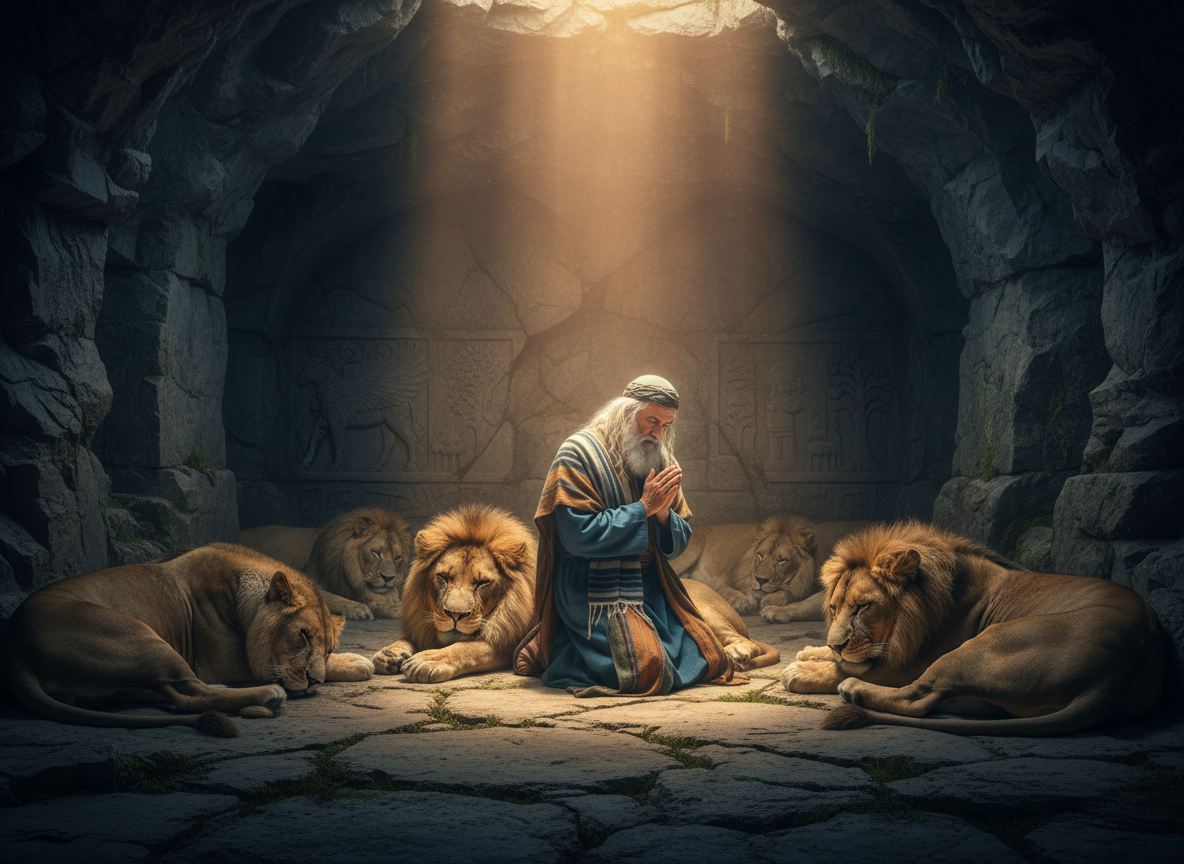
Daniel in the lions’ den is one of the Bible’s most familiar accounts, but familiarity can cause us to miss its setting. Daniel 6 is not simply a story about a faithful man and hungry lions. It takes place amid the fall of one empire, the rise of another, and a government in which ambition, law, religion, and royal authority collide.
Looking at that historical world does not remove the miracle from the account. Instead, it helps us understand the danger Daniel faced, the political trap set for him, and why his deliverance led a powerful ruler to proclaim the sovereignty of the living God.
The Biblical Account
Daniel 6 begins with a new ruler, Darius the Mede, reorganizing his kingdom. He appoints 120 officials—often translated as princes or satraps—and places three administrators over them. Daniel is one of the three.
Daniel distinguishes himself through what the King James Version calls an “excellent spirit.” The king considers placing him over the entire realm, provoking the jealousy of the other officials. They examine Daniel’s public service but cannot find corruption or negligence. His enemies finally conclude that they can only attack him through his faithfulness to God.
They persuade Darius to issue a thirty-day decree forbidding petitions to any god or person except the king. Violation means being thrown into a den of lions. Daniel knows that the decree has been signed, but he does not conceal or abandon his established practice. He continues praying three times each day with his windows open toward Jerusalem.
The conspirators catch him at prayer. Darius realizes too late that he has been manipulated, but the officials insist that the decree cannot be changed. Daniel is cast into the den, and a stone is placed over its opening and sealed. At dawn, the distressed king discovers that Daniel is alive. Daniel explains that God sent an angel and shut the lions’ mouths.
A Story Set After the Fall of Babylon
The previous chapter ends with the death of Belshazzar and the transfer of the kingdom to Darius the Mede. This places the narrative against the collapse of the Neo-Babylonian Empire.
The Persian conquest of Babylon in 539 BC is well established outside the Bible. The Cyrus Cylinder, now held by the British Museum, presents a Babylonian account of Cyrus the Great’s conquest and his subsequent policies. The Nabonidus Chronicle also records events surrounding Babylon’s surrender to Cyrus.
These records confirm the broad political transformation behind Daniel 5 and 6: Babylonian power ended and Persian power took control. They do not, however, independently recount Daniel’s ordeal or identify every person mentioned in the biblical narrative.
Who Was Darius the Mede?
Darius the Mede presents the largest historical question in Daniel 6. No surviving extrabiblical record has conclusively identified a ruler by that exact title who governed Babylon between Belshazzar and Cyrus.
Several explanations have been proposed. Some interpreters identify Darius with Cyrus, reading the conclusion of Daniel 6 as referring to the reign of Darius—that is, the reign of Cyrus. Others associate him with Ugbaru or Gubaru, officials connected with Babylon’s conquest and administration. A traditional identification connects him with Cyaxares II, a Median ruler described by the Greek writer Xenophon. Many modern critical scholars instead consider Darius a literary figure or a historical difficulty within the book.
The honest conclusion is that the question remains unsettled. Historical references should illuminate Scripture, but they should not be forced to provide certainty where the available evidence does not. The theological meaning of Daniel 6 does not depend upon pretending that this debate has been resolved.
Satraps and the Machinery of Empire
The officials surrounding Daniel fit the administrative world of the Medes and Persians. The Achaemenid Empire governed its enormous territory through provinces commonly called satrapies. According to Encyclopaedia Iranica, this system enabled the empire to collect taxes, recruit troops, supervise local bureaucracies, defend its borders, and respond to rebellion.
Daniel 6 is therefore filled with the concerns of imperial administration: appointments, financial accountability, access to the king, written decrees, accusations of disloyalty, and officials competing for influence. Daniel’s enemies do not challenge his competence. They weaponize bureaucracy and royal vanity because his official record gives them nothing else to use.
The exact number and titles in Daniel should not automatically be equated with the later standardized system of Darius I. Imperial organization changed over time, and ancient titles can be difficult to translate precisely. Still, the chapter’s portrait of layered provincial government belongs naturally to the broader administrative culture of the Persian Empire.
The King’s Seal and an Unchangeable Sentence
After Daniel is placed in the den, a stone covers its opening. The king seals it with his signet and with the signets of his nobles so that Daniel’s fate cannot be secretly altered. Seals served as marks of authority, identity, and authentication throughout the ancient Near East.
Surviving seals and seal impressions from Persepolis demonstrate their importance within Achaemenid administration. The Metropolitan Museum of Art also preserves an Achaemenid cylinder seal dating from approximately the sixth to fourth century BC. These artifacts do not prove the specific sealing described in Daniel, but they show that the detail belongs to a genuine culture of official authentication.
The double sealing is also important within the story. Neither Daniel’s supporters nor his enemies are supposed to interfere. The situation is placed beyond human alteration. When Daniel emerges alive, his rescue cannot easily be dismissed as an administrative favor or a secret escape.
Why Lions?
Lions carried enormous royal symbolism in the ancient Near East. They represented strength, danger, and the ruler’s ability to impose order. The famous Assyrian lion-hunt reliefs in the British Museum, created before the Persian conquest of Babylon, portray King Ashurbanipal hunting lions released into a controlled arena.
These images show that lions could be captured, kept, and deliberately released under royal supervision. They provide useful cultural background for the idea of a ruler maintaining lions, but they are not archaeological evidence of Daniel’s den. The reliefs are Assyrian rather than Persian and depict royal hunts rather than executions. The distinction matters.
Within Daniel 6, the lions embody a death sentence that no human being can survive unaided. The king possesses lions, soldiers, laws, seals, and political authority, yet he is powerless to rescue Daniel from his own decree. God needs none of those things. He simply shuts the lions’ mouths.
Daniel Prayed Toward Jerusalem
Daniel’s response to the decree is remarkably restrained. He does not begin a public spectacle, threaten the government, or alter his routine to impress others. He continues doing what he had already been doing: kneeling, giving thanks, and praying three times a day.
His open windows face Jerusalem. This practice connects naturally with Solomon’s prayer at the dedication of the Temple. In 1 Kings 8:46–50, Solomon anticipates Israel being taken captive to a foreign land and asks God to hear His people when they repent and pray toward their land, Jerusalem, and the Temple.
Daniel is living within that exile. Jerusalem lies damaged and distant, but God’s covenant promises have not been forgotten. His direction of prayer is therefore not superstition. It expresses hope in God’s promises and identification with God’s people.
Faithfulness Before the Crisis
One of the most important phrases in the chapter is that Daniel prayed “as he did aforetime.” The lions’ den did not create Daniel’s faith. It revealed the faith that years of prayer, service, and obedience had already formed.
Matthew Henry’s public-domain commentary draws a helpful contrast between Daniel 3 and Daniel 6. Daniel’s companions faced the furnace because they refused to commit an evil act; Daniel faced the lions because he refused to neglect a faithful duty. In both accounts, loyalty to God takes priority over an imperial command.
Daniel is not reckless. Nor does he depend on his distinguished career to protect him. He obeys God, accepts the consequences, and leaves the outcome in God’s hands.
Faithfulness when rescue does not come immediately
Daniel’s rescue should encourage trust in God without becoming a promise that every faithful person will escape suffering. Hebrews remembers those who, through faith, “subdued kingdoms, wrought righteousness, obtained promises, stopped the mouths of lions” (Hebrews 11:33, KJV). Yet the same chapter also remembers faithful people who endured imprisonment, mistreatment, and death. Both groups belong to its account of faith (Hebrews 11:35-40).
The difference in their earthly outcomes does not mean that one group trusted God and the other failed. Scripture directs our hope beyond the immediate crisis to God’s final vindication of His people. Daniel’s friends had already expressed this confidence when they told Nebuchadnezzar that they would remain faithful even if God did not rescue them from the furnace (Daniel 3:16-18).
An early Christian reader made a closely related connection. First Clement 45 recalls Daniel’s persecution while warning a divided church against envy and mistreatment of the righteous. The letter uses Daniel to challenge the conduct of its readers. It is evidence of how early Christians received the story, rather than an independent historical account of the lions’ den.
For us, the question reaches beyond whether a particular difficulty ends quickly. Are we continuing to pray, acting honestly, and refusing to imitate the wrongdoing around us? Daniel’s example calls us to that steady faithfulness while we entrust the outcome to God.
Daniel 6:24 also records the execution of the accusers and their families by the king. That disturbing royal action belongs to the narrative; it is not a command for Christians to imitate. Deuteronomy 24:16, by contrast, forbids putting children to death for their fathers and fathers for their children. Daniel’s rescue should not be used to justify collective punishment.
The Living God and the Limits of Empire
Darius spends the night fasting and unable to sleep. The ruler who signed the decree cannot reverse it, and the man surrounded by royal power cannot save his most trusted official. At dawn, he approaches the den and asks whether Daniel’s God has been able to deliver him.
Daniel answers that God sent His angel and shut the lions’ mouths. The king then declares that Daniel’s God is the living God whose kingdom will not be destroyed.
That declaration is the chapter’s answer to imperial pride. Babylon fell. Persia eventually fell. Every earthly ruler discovers the limits of decrees, armies, wealth, and reputation. God’s dominion does not depend upon any of them.
Daniel 6 is consequently more than a lesson about courage. It is a declaration about sovereignty. Human authorities may manipulate law, criminalize faithfulness, and place the innocent in situations from which no earthly rescue appears possible. Yet their authority remains temporary and limited. The God whom Daniel served continually remains the living God.
What Daniel’s Example Means Today
- Integrity matters before persecution arrives. Daniel’s enemies could find no corruption in his work.
- Consistent prayer prepares believers for a crisis. Daniel did not invent a spiritual routine after the decree was issued.
- Faithfulness does not require theatrical defiance. He quietly continued honoring God.
- Government power has limits. Darius could issue a law but could not control its consequences or save Daniel from it.
- God’s sovereignty outlasts every empire. Kings and kingdoms pass away, but the living God endures.
Historical evidence helps us see that Daniel’s world was not an empty stage. It was a world of collapsing kingdoms, expanding imperial bureaucracy, sealed decrees, royal symbols, and political rivalry. Against that vast machinery stands one elderly exile at prayer.
The empire appeared to hold every advantage. Daniel possessed only his integrity, his established faith, and his trust in God. By morning, those proved to be enough.
Leave a Reply