
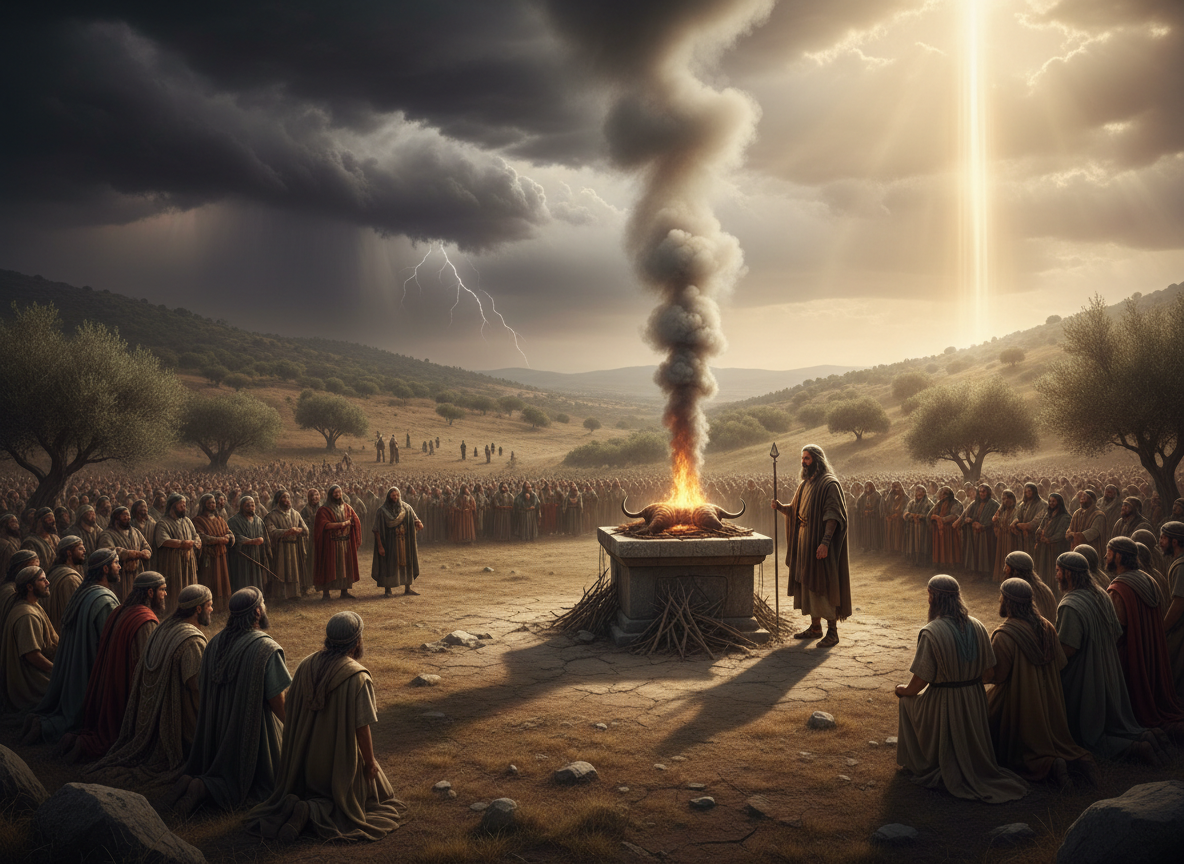
Billy Graham’s challenge based on Elijah and the prophets of Baal confronts a habit that is still common: postponing a decision about God. We may avoid openly rejecting Him while also refusing to follow Him. Yet biblical faith is not neutrality. It is trust expressed through allegiance.
Elijah’s Question on Mount Carmel
Israel had been drawn into the worship of Baal during the reign of Ahab and Jezebel. On Mount Carmel, Elijah did more than challenge false prophets; he challenged a divided people.
“And Elijah came unto all the people, and said, How long halt ye between two opinions? if the Lord be God, follow him: but if Baal, then follow him. And the people answered him not a word.”
1 Kings 18:21 (KJV)
Their silence leaves Elijah’s question unanswered. Elijah insisted that the truth about God demanded a response. The fire that later fell did not create a second god or establish a temporary preference. It revealed the Lord as the true God and exposed Baal’s powerlessness.
A return to the God of the covenant
Before Elijah prays, he repairs the Lord’s broken altar and takes twelve stones corresponding to the tribes descended from Jacob. The action recalls the identity of the people standing before him. This is a summons to return to the God with whom Israel already stands in covenant (1 Kings 18:30-32).
Elijah’s prayer makes the purpose of the confrontation plain: “Hear me, O LORD, hear me, that this people may know that thou art the LORD God, and that thou hast turned their heart back again” (1 Kings 18:37, KJV). The prophet seeks the people’s return to God. The spectacle serves that purpose.
That context also helps us apply the passage responsibly. A person who brings difficult questions to God is not necessarily doing what Israel is doing here. Scripture includes prayers of confusion, grief, and requests for wisdom. James 1:5 invites those who lack wisdom to ask God. The challenge concerns the allegiance that governs our lives, including the choices we keep postponing when the right course is already clear.
The Didache’s opening chapter offers an early Christian parallel. It describes the way of life through love of God, love of neighbor, generosity, and prayer for enemies. Its value here is concrete: following God becomes visible in how we treat people. This later teaching document helps illustrate Christian discipleship while Scripture remains the basis of the article’s argument.
The Choice Scripture Places Before Us
This same pattern appears throughout Scripture. Moses told Israel to choose life (Deuteronomy 30:19–20). Joshua declared that his household would serve the Lord (Joshua 24:15). Jesus warned that no one can serve two masters (Matthew 6:24). The names change, but the divided heart remains the issue.
Modern idols rarely look like carved statues. Wealth, approval, pleasure, career, politics, entertainment, or personal independence can take God’s rightful place. A good thing becomes an idol when it receives the trust, obedience, or devotion that belongs to God.
An Early-Christian Parallel: The Two Ways
The Didache, chapter 1, an early Christian teaching document rather than a book of Scripture, opens with a striking summary: there are two ways, one of life and one of death. It describes the way of life through love of God and neighbor and contrasts it with conduct that rejects God’s commands. The Epistle of Barnabas, chapters 18–20, uses a similar “Two Ways” framework.
These early believers understood discipleship as a road traveled, not merely an opinion held. That echoes Elijah’s demand: if the Lord is God, follow Him. A confession that never affects direction, loyalty, or conduct has not answered the question fully.
What Following God Requires
Choosing God does not mean earning salvation through perfect behavior. Salvation is God’s gift received through faith in Jesus Christ. But genuine faith turns toward Christ, repents of sin, and begins learning obedience. The decision is personal, yet Jesus also called people to confess Him openly rather than hide their allegiance.
“For whosoever shall call upon the name of the Lord shall be saved.”
Romans 10:13 (KJV)
The invitation is gracious, but it is not trivial. Christ calls us to surrender the throne of our lives. We cannot keep Him as one interest among many while another master governs our choices.
Questions for Reflection
- What receives my deepest trust? Where do I turn first for security, identity, or hope?
- What am I delaying? Is there a command I already understand but continue postponing?
- What would following God change? A sincere decision should reach our habits, relationships, priorities, and use of time.
The Time to Choose
Elijah’s words are not an invitation to panic or make an empty emotional promise. They are a call to stop hiding behind indecision. Examine the claims of Christ, count the cost honestly, and respond to the One who gave Himself for sinners and rose again.
You can watch the first section of the Billy Graham sermon compilation, approximately 7:30–22:50. The sermon can point us toward Scripture, but Scripture remains the authority by which every message must be tested.
A Prayer of Commitment
Lord God, reveal the divided places in my heart. Forgive me for giving created things the devotion that belongs to You. Help me turn from sin, trust Jesus Christ, and follow You without pretending that neutrality is possible. Give me courage to live openly and faithfully as Your servant. Amen.
Leave a Reply