
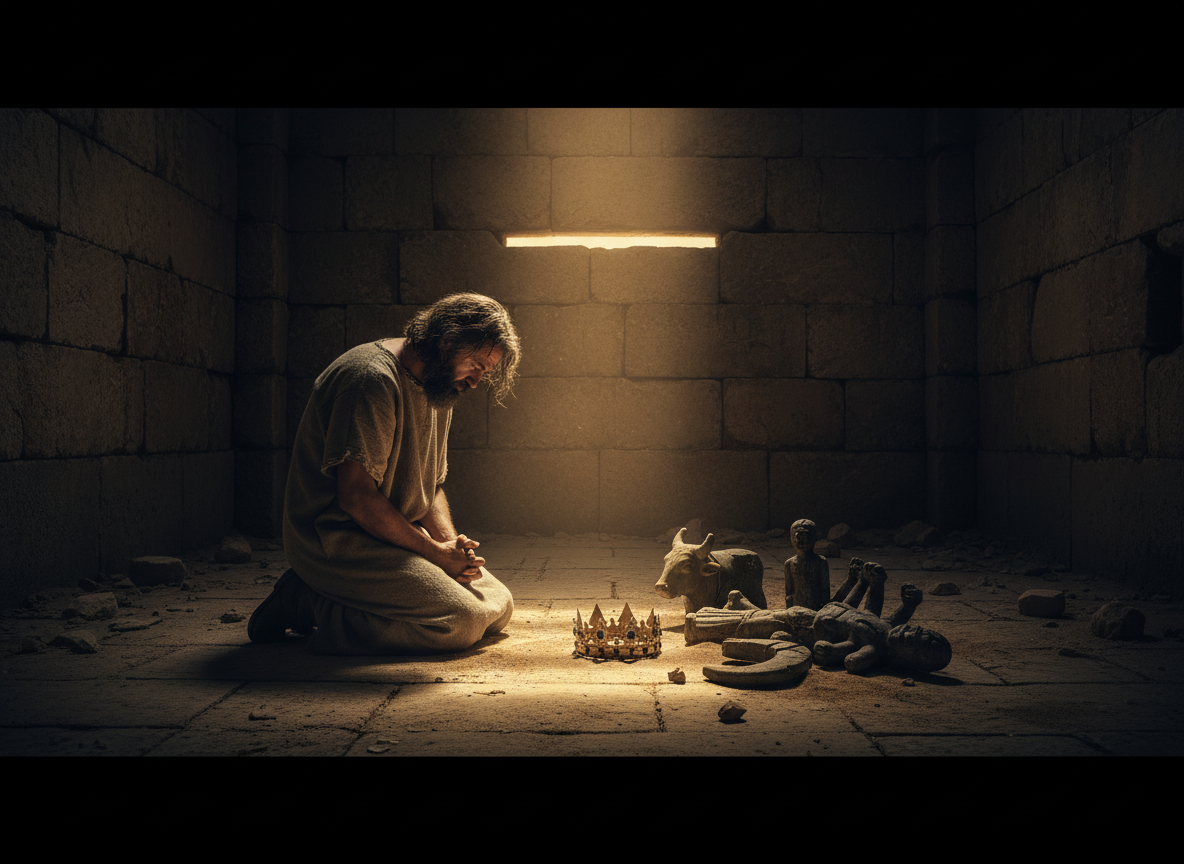
Manasseh’s life is among Scripture’s darkest warnings—and one of its most startling demonstrations of mercy. His story refuses two comforting lies: that sin has no serious consequences, and that some sinners are beyond the reach of repentance.
A King Who Led Judah into Evil
Manasseh became king of Judah and reversed many of his father Hezekiah’s reforms. He rebuilt idolatrous altars, practiced occult arts, desecrated the temple, and led the nation into grievous sin. Second Kings emphasizes the scale of his corruption and the innocent blood shed during his reign.
“And he did that which was evil in the sight of the Lord, after the abominations of the heathen, whom the Lord cast out before the children of Israel.”
2 Chronicles 33:2 (KJV)
Idolatry is never merely private. What rules the heart eventually shapes decisions, relationships, institutions, and communities. Leaders carry an especially grave responsibility because their example and authority can normalize evil.
God Sees Beneath Appearances
“I the Lord search the heart, I try the reins, even to give every man according to his ways, and according to the fruit of his doings.”
Jeremiah 17:10 (KJV)
In biblical language, the “reins” refer to the inward parts—the hidden motives and desires. God’s judgment is not limited by appearances, reputation, or excuses. He sees the roots from which our actions grow and the fruit they produce.
That truth should humble both the openly rebellious and the outwardly religious. Respectability cannot conceal an unrepentant heart from God. At the same time, no honest cry for mercy is hidden from Him.
Manasseh Brought Low
God warned Manasseh and the people, but they refused to listen. According to 2 Chronicles 33:11, the captains of the king of Assyria captured Manasseh, bound him, and carried him to Babylon. This is his personal captivity under Assyrian power, not Judah’s later Babylonian exile. The king who had exalted false gods was brought into humiliation.
“And when he was in affliction, he besought the Lord his God, and humbled himself greatly before the God of his fathers, And prayed unto him: and he was intreated of him, and heard his supplication.”
2 Chronicles 33:12–13a (KJV)
His suffering did not automatically save him. The turning point was that he humbled himself and sought the Lord. God heard him, restored him to Jerusalem, and Manasseh then removed idols and commanded Judah to serve the Lord.
Repentance Is More Than Regret
Regret grieves over consequences. Repentance turns toward God. Manasseh’s later actions did not erase every consequence of his earlier reign, but they demonstrated that his change was more than a passing emotion.
The First Epistle of Clement, chapters 7–8, an early Christian letter and not Scripture, urges its readers to consider generations in which those who turned to God received mercy. Clement presents repentance as an open invitation from a holy and compassionate God, while still calling sin what it is.
Polycarp to the Philippians 11 similarly counseled Christians not to treat a fallen person simply as an enemy, but to seek the person’s restoration as a straying member. Christian mercy neither excuses wrongdoing nor declares the wrongdoer unreachable.
Why we should read both accounts
Second Kings 21 and 2 Chronicles 33 present different emphases within Manasseh’s story. Kings gives particular attention to the idolatry and bloodshed associated with his reign. Chronicles also records his humiliation, prayer, return to Jerusalem, and subsequent reforms. Reading the two accounts together allows the damage and the mercy to remain visible.
Chronicles describes actions that follow Manasseh’s prayer: he removes foreign gods and altars, repairs the Lord’s altar, and commands Judah to serve the Lord. Yet the account also observes that the people continue sacrificing at the high places, although to the Lord their God (2 Chronicles 33:15-17). His return does not instantly undo the religious habits formed during his reign.
Kings likewise continues to connect Judah’s later judgment with Manasseh’s sins and the innocent blood he shed (2 Kings 23:26; 24:3-4). Personal repentance and the lasting consequences of public wrongdoing therefore have to be discussed together. Forgiveness is not a declaration that those harmed no longer matter.
First Clement 7-8 calls readers to repentance by recalling God’s mercy across earlier generations. Polycarp to the Philippians 11 applies a similar concern to a fallen church leader, urging the community to seek restoration without excusing the offense. These are helpful early Christian parallels. For a reader today, the response includes confession, a changed course of action, and a willingness to address harm wherever repair is possible.
No Sin Should Be Treated Lightly
“For the wages of sin is death; but the gift of God is eternal life through Jesus Christ our Lord.”
Romans 6:23 (KJV)
Grace is not proof that sin is harmless. The cross shows both its terrible cost and the depth of God’s love. We should never use Manasseh’s restoration as permission to delay repentance. Continued rebellion hardens the heart and harms people around us.
No Repentant Sinner Is Beyond Hope
“If we confess our sins, he is faithful and just to forgive us our sins, and to cleanse us from all unrighteousness.”
1 John 1:9 (KJV)
Forgiveness rests on God’s faithfulness and the work of Christ—not on our ability to make our past small. Some earthly consequences may remain, restitution may be necessary, and trust may take time to rebuild. Yet the repentant sinner can truly be forgiven and transformed.
Turning toward God Today
Name sin honestly. Stop defending it. Bring it into the light before God. Trust Christ rather than promising to repair yourself first. Where possible, remove what leads you back into sin and make right what you have harmed. Seek mature Christian help when the struggle has become entrenched.
You can watch the third section of the Billy Graham sermon compilation, approximately 42:08–1:01:59. Read Manasseh’s accounts in 2 Kings 21 and 2 Chronicles 33 to see both the damage he caused and the mercy he received.
A Prayer of Repentance
Merciful God, You know my actions and the hidden motives of my heart. I confess my sin without excuse. Thank You that Jesus Christ died for sinners and that Your mercy reaches those who truly turn to You. Give me strength to abandon what is evil, repair what I can, and walk in faithful obedience. Amen.
Leave a Reply