
Anyone who has searched for work online knows the routine: find an opening, adjust the résumé, fill out an application, answer screening questions, and then wait.
Sometimes the rejection eventually arrives. Sometimes nothing arrives at all.
But there is an increasingly discussed third possibility: the employer may never have intended to hire anyone in the first place.
These advertisements have become known as “ghost jobs”—job postings for positions that do not exist, are already filled, or that an employer has no immediate intention of filling.
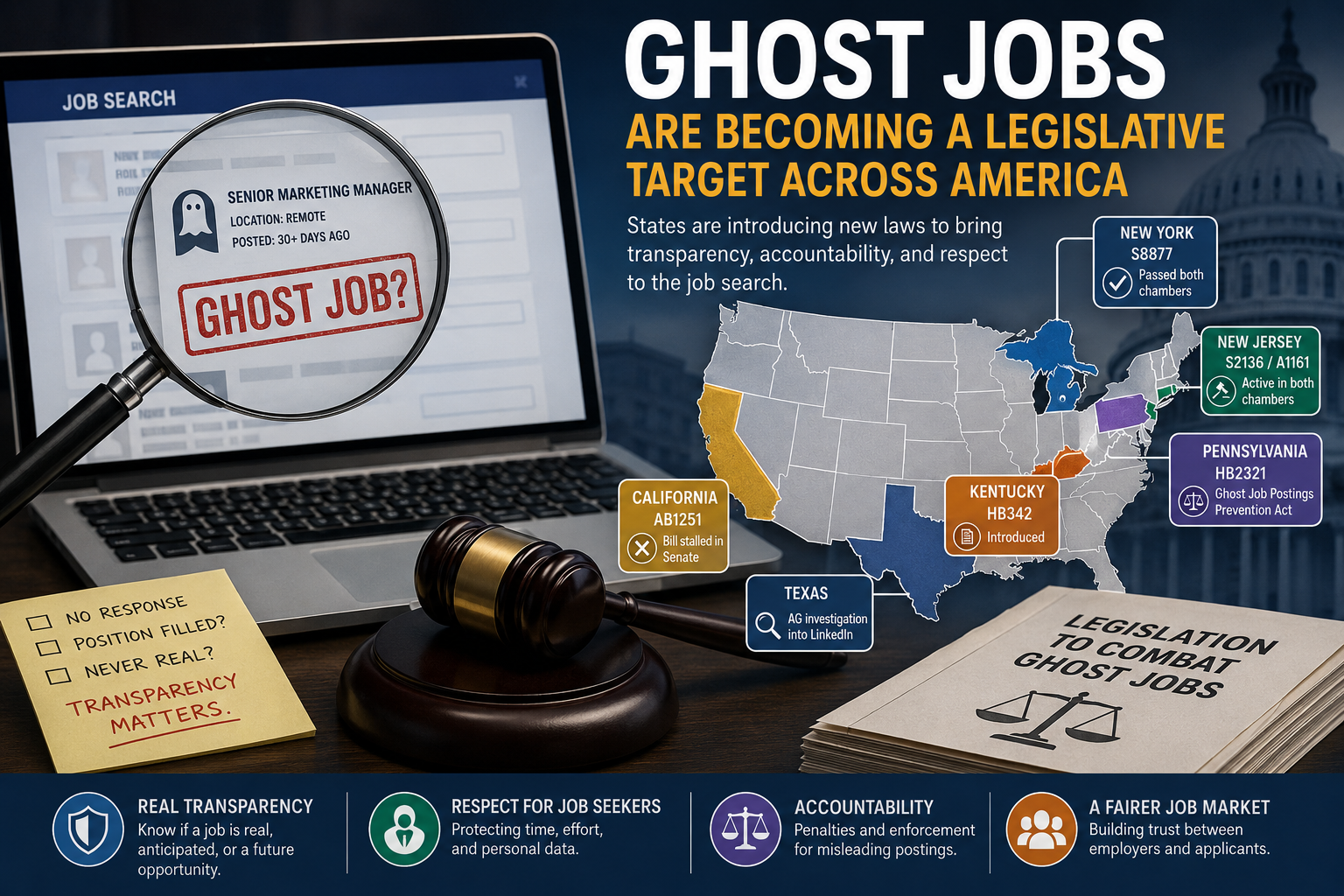
The practice has attracted enough attention that lawmakers in several states are now considering legislation specifically designed to combat it. New York has already passed a major ghost-job transparency bill through both chambers of its legislature, while New Jersey, Pennsylvania and Kentucky have considered their own versions. California made a significant attempt in 2025, and Texas has entered the fight through a consumer-protection investigation involving LinkedIn.
For job seekers tired of wondering whether the jobs they apply for are even real, the rules of online hiring may finally be beginning to change.
What Exactly Is a Ghost Job?
The Congressional Research Service defines ghost-job postings broadly as online advertisements for positions that either do not exist or that employers are not planning to fill immediately.
Not every stale job advertisement is necessarily malicious.
An employer might originally intend to hire and later freeze the position. A job board might automatically copy an advertisement from another website and fail to remove it after the original disappears. Companies may also recruit continuously for positions with high turnover.
But there are more deliberate reasons.
Employers may advertise positions to collect résumés for a future talent pool, test how many qualified applicants are available, give employees the impression that additional help is coming, suggest that a company is expanding, or search for an unusually strong applicant even though no immediate vacancy exists.
The Congressional Research Service has also noted that companies may advertise externally even when they expect to hire an internal candidate.
The problem is simple: the applicant usually has no way of knowing which type of advertisement they are looking at.
New York Could Set the Standard
New York’s S8877 is currently one of the most advanced ghost-job proposals in the United States.
The bill passed the New York Senate on April 28, 2026 and the Assembly on June 2. As of August 22, the state legislature still lists it as having passed both chambers, rather than as enacted law.
The proposal would require covered employers and third-party job-posting companies to disclose whether an advertised position represents an actual current vacancy.
Employers would also have to provide information about when they expect to fill the position. Once a job is filled, the advertisement generally would have to be removed within two weeks.
And there would be consequences for ignoring the rules.
Violations could result in a $2,500 fine for each publication or digital platform on which the advertisement appears, with penalties doubling for every additional 30-day period that a violating advertisement remains posted.
That represents a significant shift in philosophy.
Instead of outlawing every form of advance recruiting, New York’s approach is essentially saying:
If there isn’t an open job, tell the applicant.
New Jersey Wants Hiring Intentions Disclosed
New Jersey is pursuing a similar approach through S2136 and A1161.
The Senate version passed the Senate Labor Committee with amendments on May 11, 2026 and was referred to the Senate Budget and Appropriations Committee. The Assembly version has also advanced from its Labor Committee.
The proposal would require an advertisement to disclose whether it represents an existing vacancy.
For a real vacancy, the employer would provide an estimated timeframe for filling it.
The bill also recognizes that companies sometimes legitimately recruit ahead of anticipated openings. Rather than banning this entirely, the current Senate version would allow certain advertisements for anticipated vacancies if they are clearly labeled and if the employer has a demonstrated history of hiring for similar positions.
Those anticipated-vacancy advertisements would also expire rather than remaining online indefinitely.
That distinction is important.
There is nothing inherently wrong with a company saying:
“We expect to need employees in this position soon and are accepting applications now.”
The problem comes when that advertisement is presented as if someone is being hired today.
Pennsylvania Is Considering an Even Broader Crackdown
Pennsylvania’s HB2321 is formally titled the Ghost Job Postings Prevention Act.
Introduced on March 26, 2026, the bill was referred to the Pennsylvania House Labor and Industry Committee, where it remained as of August.
Pennsylvania’s proposal is notable because it goes beyond simply putting a label on advertisements.
Its sponsors say the legislation is intended to require greater transparency involving hiring intentions, salary information, hiring dates and the use of artificial intelligence in the hiring process.
It would prohibit false or misleading job advertisements and impose requirements concerning whether positions actually exist.
The proposal also tackles another concern that often gets overlooked in the ghost-job debate: applicant data.
A résumé can contain someone’s name, employment history, education, contact information, professional qualifications and other valuable information. If there was never a job available, applicants may reasonably wonder why that information was being collected in the first place.
Pennsylvania’s proposal therefore connects ghost-job transparency with limits on how applicant information can be retained, mined or sold.
If that approach eventually becomes law, it could turn ghost-job regulation into something much larger than an employment-law issue. It could become a data-privacy issue as well.
Kentucky Has Tried to Ban the Practice Directly
Kentucky has taken a more straightforward approach.
HB342, introduced January 13, 2026, would create a provision in Kentucky labor law prohibiting employers from publishing ghost-job postings and establish penalties for violations.
The measure was sent to the House Economic Development and Workforce Investment Committee on January 21 and had not advanced beyond that stage as of August 2026.
Kentucky attempted similar legislation during the previous session through HB57, which did not pass.
That illustrates an important point about the ghost-job movement: interest is growing, but passage is far from guaranteed.
California Tried—and the Bill Stalled
California’s AB1251 would have required private employers publicly advertising a job to clearly state whether the advertisement represented an actual vacancy.
The legislation passed the California Assembly in June 2025 and advanced into the Senate. However, it was eventually held under submission in the Senate Appropriations Committee in August 2025 rather than being enacted.
The proposal nevertheless shows how quickly the issue spread.
California already has extensive rules concerning information that must appear in employment advertisements, particularly salary information. Ghost-job disclosure would have added another layer: not simply what does the job pay?, but does the job actually exist?
Texas Is Taking a Different Route
Texas does not currently have the same kind of ghost-job transparency bill moving through its legislature.
But the state has entered the debate in another way.
On July 14, 2026, Texas Attorney General Ken Paxton announced an investigation into LinkedIn over allegations involving fake or misleading job opportunities advertised to users, particularly people paying for LinkedIn Premium services.
The Attorney General’s office issued a Civil Investigative Demand seeking documents and internal communications concerning LinkedIn’s job-posting verification practices, advertising and Premium subscription marketing.
The investigation is especially interesting because it approaches ghost jobs as a consumer-protection issue.
If someone pays for a premium employment-search service partly because they believe it gives them access to legitimate employment opportunities, the question becomes whether the platform has adequately represented what those listings actually are.
No finding of wrongdoing should be assumed merely because an investigation has been opened. But the Texas action demonstrates that states may not necessarily need a statute carrying the words “ghost job” before regulators begin looking at potentially deceptive employment advertising.
Washington Is Paying Attention Too
There is not yet a federal law specifically prohibiting ghost-job advertisements.
However, federal officials are paying closer attention.
On June 18, 2026, U.S. Senator Ruben Gallego of Arizona sent letters to the Department of Labor, Federal Trade Commission and Bureau of Labor Statistics asking what the federal government is doing about ghost jobs.
Among other questions, Gallego asked whether regulators consider ghost jobs deceptive advertising, whether the FTC has considered requiring employers or hiring platforms to disclose when a posting is not tied to an active vacancy, and whether ghost jobs could affect perceptions of the labor market.
Federal consumer-protection laws may already apply in some particularly deceptive circumstances. The Congressional Research Service has noted that Section 5 of the Federal Trade Commission Act prohibits unfair or deceptive acts or practices, although proving that a particular ghost-job advertisement violates existing law could involve difficult questions about an employer’s intent.
Do Ghost Jobs Distort Unemployment and Job-Opening Numbers?
This part deserves some caution.
It is tempting to assume that thousands of fake advertisements automatically inflate the federal government’s official count of job openings.
That is not necessarily true.
The Bureau of Labor Statistics’ Job Openings and Labor Turnover Survey, or JOLTS, does not simply count advertisements appearing on LinkedIn, Indeed or other websites.
Employers responding to JOLTS are supposed to report a position as open only when a specific position exists, work is available, the employee could start within 30 days and the employer is actively recruiting outside candidates.
The Congressional Research Service therefore concluded that, assuming employers answer the survey accurately, official JOLTS figures are unlikely to simply count ordinary online ghost postings.
Ghost jobs can still distort the job seeker’s perception of the labor market, however.
If someone opens a job board and sees hundreds of apparent openings, that person reasonably assumes hundreds of employers are trying to hire.
If a substantial portion are stale, speculative or nonexistent, the online labor market can look considerably healthier than the employment opportunities actually available to applicants.
The Solution May Be Disclosure Rather Than an Absolute Ban
Employers do have legitimate reasons to recruit before a position officially opens.
Hospitals, retailers, restaurants, manufacturers and other organizations with recurring staffing needs may need a constant pipeline of candidates.
Companies also cannot always predict whether a planned position will ultimately receive funding.
That is why some of the strongest proposals do not simply outlaw every advertisement without an immediately empty chair.
Instead, they emphasize truthful labeling.
A future hiring pool could say it is a future hiring pool.
An anticipated opening could say it is anticipated.
A currently funded vacancy could say the company is actively hiring.
And when a position has been filled, the listing could be removed.
None of these requirements prevent employers from recruiting.
They simply give applicants information that employers already possess.
Job Seekers Deserve to Know Whether the Job Exists
Applying for employment is not free.
Even when no application fee is involved, applicants spend something considerably more valuable: their time.
They research companies. They rewrite résumés. They prepare cover letters. They complete assessments. They enter employment histories into forms after already uploading a résumé containing the exact same information. Some prepare for interviews, buy clothing, rearrange work schedules or travel.
Doing all of that for a legitimate opening that eventually goes to another applicant is an unavoidable part of competition.
Doing it for a job that was never available is something else entirely.
That distinction appears to be catching lawmakers’ attention.
New York, New Jersey, Pennsylvania, Kentucky and California have now placed ghost-job transparency into the legislative conversation. Texas has demonstrated that existing consumer-protection authority may provide another avenue. Federal lawmakers are asking regulators what role Washington should play.
The eventual details will differ from state to state.
But the principle emerging from all of them is remarkably simple:
A person applying for a job should have the right to know whether there is actually a job to apply for.
Leave a Reply