
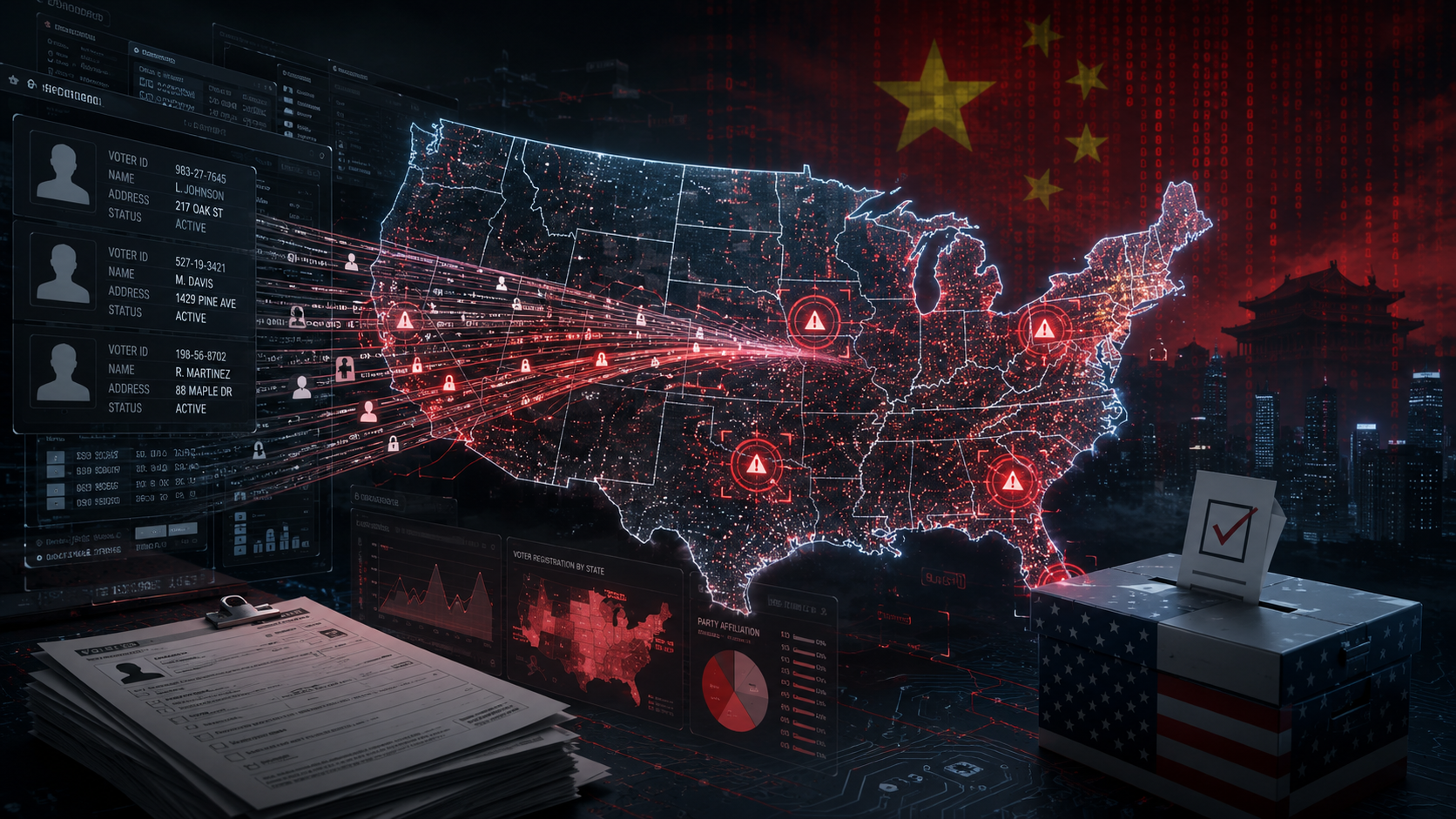
President Donald Trump has accused China of carrying out what he described as the largest compromise of election data in history, claiming that Beijing obtained information connected to approximately 220 million American voters.
During a nationally televised address, Trump said the alleged operation began during the 2020 election cycle and involved names, addresses, telephone numbers, political-party preferences and other personal information. The White House further alleged that Chinese intelligence established a specialized unit to examine and exploit the acquired data.
According to the administration, intelligence agencies discovered in 2020 that voter information from 18 states had been “bought, stolen, or hacked” by China. Trump also accused members of the American intelligence community of suppressing or minimizing information about the alleged compromise.
The accusation is serious. A foreign government possessing a database containing information on most American voters could use it for intelligence gathering, targeted propaganda, identity fraud, phishing operations or highly personalized political-influence campaigns.
However, obtaining voter information is not automatically the same as altering an election.
What the 2021 intelligence assessment concluded
A declassified Intelligence Community Assessment released in March 2021 examined foreign threats surrounding the 2020 federal election. It concluded that intelligence agencies had found no indication that any foreign actor attempted to alter voter registration, ballot casting, vote tabulation or the reporting of election results.
That assessment also concluded with high confidence that China considered—but did not deploy—interference or influence operations intended to change the presidential election’s outcome. A dissenting intelligence official believed China had taken some steps to undermine Trump’s reelection prospects through public statements, media and social-media activity, but agreed that there was no information showing China had interfered with the election process itself.
The same report nevertheless acknowledged that Beijing had engaged in long-running efforts to collect information about American voters, public opinion, political parties, candidates, campaign employees and senior government officials. Intelligence analysts believed China could use that information to predict electoral outcomes and shape American policy toward China.
This means the older intelligence assessment does not necessarily dispute that China collected voter information. It disputes the larger claim that Beijing used that information to interfere with voting infrastructure or change the election result.
What remains unproven
The newly released material may provide additional information about the scale of China’s data collection, but the documents made public so far have not established that China changed voter registrations, manufactured ballots, altered vote totals or manipulated the final result of the 2020 election.
Reuters reported that many of the documents released by the administration did not support the most expansive claims made during Trump’s speech. One document reportedly concluded that vote-tabulation systems would be difficult to manipulate on a scale large enough to compromise an election. Another stated that Beijing did not intend to conduct covert operations aimed at swaying the result.
Reuters also cited people familiar with the matter who said at least some of the voter information acquired by China was not confidential. Political organizations and consultants routinely obtain voter-registration information, although access rules and the information available vary by state.
That does not make foreign acquisition harmless. A database does not need to contain ballots or voting-machine passwords to become a national-security threat. Information assembled from voter files, commercial databases, breached accounts and social-media profiles can allow a foreign intelligence service to build detailed profiles of millions of Americans.
What has not been publicly demonstrated is the next step: that China used those records to submit fraudulent registrations, cast illegal ballots, alter election systems or determine the winner.
China denies the allegations
China has rejected Trump’s accusations. Foreign Ministry spokesperson Lin Jian described them as fabricated and intended to vilify China, maintaining that Beijing has never interfered in an American election.
China’s denial should not by itself settle the issue. Governments routinely deny intelligence operations. At the same time, allegations of this magnitude require verifiable evidence, particularly when they are being used to question the legitimacy of an American presidential election.
A massive security concern—but not yet proof of a stolen election
The most defensible conclusion from the available information is that China appears to have conducted extensive intelligence collection involving American voters and political organizations. The Trump administration now alleges that this activity included the illicit acquisition of 220 million voter files—an extraordinary figure that deserves a complete investigation and greater public disclosure.
But three separate claims must not be treated as interchangeable:
China obtained American voter information.
China intended to use that information for intelligence or political influence.
China used that information to alter the 2020 election.
Evidence supporting the first claim does not automatically prove the third.
The release raises legitimate questions about voter-data security, foreign intelligence collection and what government agencies knew during the 2020 election. It may also justify stronger protections for voter databases and stricter controls over how voter information is purchased, transferred and stored.
For now, however, the public record does not prove that China changed votes or overturned the legitimate result of the 2020 presidential election. The reported data acquisition may represent an enormous cybersecurity and counterintelligence failure, but describing it as proof of election fraud goes beyond the evidence that has been publicly released.
The White House — Election Integrity and Declassified Documents
https://www.whitehouse.gov/election-integrity/
Office of the Director of National Intelligence — Intelligence Community Assessment on Foreign Threats to the 2020 U.S. Federal Elections
https://www.dni.gov/index.php/newsroom/reports-publications/reports-publications-2021/3521-intelligence-community-assessment-on-foreign-threats-to-the-2020-u-s-federal-elections
Reuters — Trump Accuses China of 2020 Election Interference, Contradicting U.S. Intelligence Findings
https://www.reuters.com/legal/government/with-midterms-deck-trump-deliver-primetime-speech-election-security-2026-07-16/
Reuters — Trump Puts Election Security at Center of Republicans’ Midterm Fight
https://www.reuters.com/legal/government/trump-puts-election-security-center-republicans-midterm-fight-2026-07-17/
Reuters — White House Weighed Releasing Intelligence on China and the 2020 Election
https://www.reuters.com/legal/government/white-house-weighs-releasing-controversial-intel-china-us-elections-sources-say-2026-07-15/
Associated Press — China Rejects Trump’s Election-Interference Allegations
https://apnews.com/article/e4e9afe16a4e30123293c3f4ff6ed6bd
Leave a Reply