
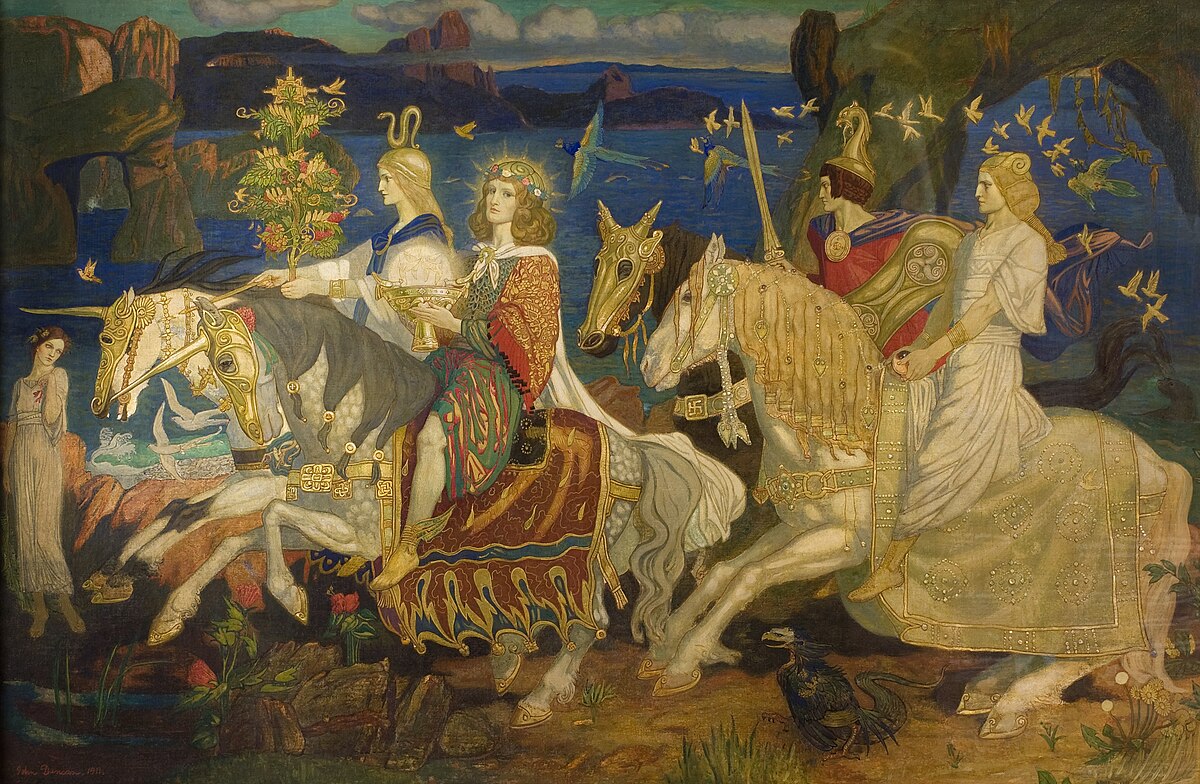
1. Pre-Christian Myth & the Tuatha Dé Danann
In Irish mythology, one of the foundational supernatural peoples is the Tuatha Dé Danann (“folk of the goddess Danu”). Wikipedia+2Wikipedia+2 They are depicted as god-like beings: skilled in magic, arts and crafts, inhabiting an Otherworld, battling the Fomorians, and having dominion over the land. Wikipedia+2Wikipedia+2
In the legendary book of invasions (Lebor Gabála Érenn), the story goes that after their defeat by the human invaders (the Milesians) the Tuatha Dé Danann retreated into the earth—into hills, mounds, and an alternative realm of being. Wikipedia
Thus, over time, the gods of old became the “fair folk” (the fae) of folk belief.
2. The Aos Sí (“People of the Mounds”) & Fairy-Faith
The term Aos Sí (or aes sídhe) means literally “folk of the síd(he)” — the tired old word for fairy-mound or burial-mound. Wikipedia+1 These mounds (and other liminal places) were seen as entrances to the Otherworld, homes of these beings. The Irish Pagan School+1
As Irish folk belief matured, particularly under Christianisation, the fairy folk became a hybrid: part ancient gods, part earth-spirits, part enigmatic forces of nature. Scholars call the belief system around them the Creideamh Sí (“fairy-faith”) — the set of beliefs, practices and taboos surrounding the Aos Sí. HRAF+1
3. Landscape & Liminality
The fae in Ireland are strongly tied to landscape: ring-forts, cairns, caves, mounds, hawthorn trees and other “thin” places between worlds. Wilderness Ireland+1 For example, ringforts (also known colloquially as “fairy forts”) are pre-Christian circular enclosures, often now overgrown and treated with reverence and caution. Wikipedia
Because of these ties, disturbing such places (cutting bush, altering the land) was often viewed as dangerous: you weren’t just working land—you were crossing into the domain of the Good People.
Evolution Through Time
4. Christianisation & Transformation
Once Christianity spread in Ireland, the older gods had to be accommodated. Often the Aos Sí were reframed: rather than supreme deities, they became subterranean, secretive beings, perhaps fallen angels or spirits of the dead. Irish Folklore+1 Christian scribes often treated earlier myths as history or metaphor, leading to this shift.
5. Folklore, Superstition & Popular Belief
From medieval into early modern times, the fae remain vivid in folk belief: changelings (children swapped by fairies), fairies married to humans, fairy treasures, banshees (bean sí) wailing near death, fairy rings, and so on. SWW+1 The fae may be friendly or malicious, but always to be respected.
In rural Ireland, for example, local tradition held that if you disturbed a “fairy bush” (a hawthorn tree sacred to them) you might draw misfortune. A famous modern example: the Latoon Fairy Bush in County Clare was preserved during a motorway construction due to local belief in its significance. Wikipedia
6. Modern Legacy & Interpretation
Today, the fae are part of Irish cultural heritage — places are still marked as fairy-homes, folklore societies collect the tales, and the imagery of “the little people” permeates popular culture. While belief is less literal for many, the tradition remains potent. ShanOre Irish Jewlery+1
Themes & Symbolism
- Otherworld & Hidden Realm: The fae live in a world beside or beneath ours; the boundary is thin at dusk, dawn, on certain days.
- Sacred Landscape: Hills, mounds, and trees are revered and regarded as entrances or markers of fae-presence.
- Respect & Taboo: Not honouring the fae or disturbing their domain leads to harm.
- Ancestral / Divine Remnants: The fae are echoes of older gods or spirits, now hidden but still powerful.
- Liminal Time & Being: Many tales involve times when the human and fae world overlap, or beings shifting shape.

Leave a Reply