
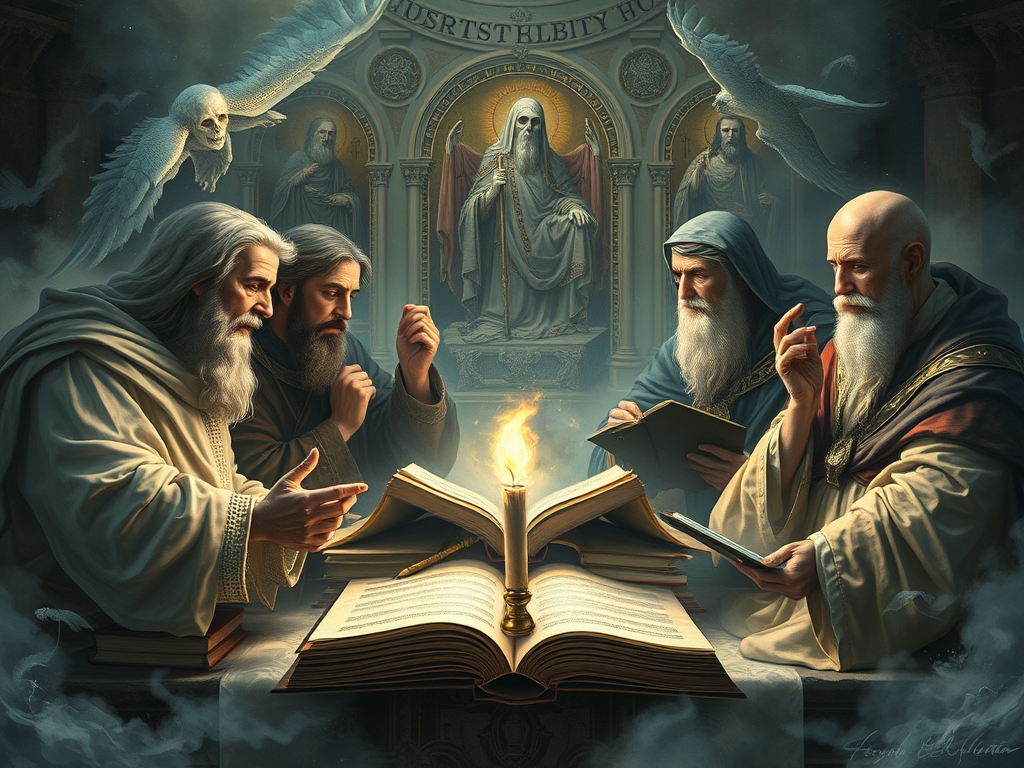
This next layer takes us deep into the Christian mystic and theological evolution of necromancy and spirit contact — from the early Church Fathers through the medieval era. It reveals how ideas about the dead, spirits, and divine vision matured into what became the Church’s doctrines on ghosts, saints, and Purgatory itself.
🕊️ 1. Early Christian Fathers (1st–4th Centuries)
After the Apostles, thinkers like Justin Martyr, Origen, Tertullian, and Augustine confronted the widespread Greco-Roman practice of summoning spirits.
Their Core View
- The dead were asleep or waiting until the resurrection.
- Any spirit appearing to the living was not truly human, but a demon imitating the dead.
- Divine visions came only from God, as with biblical prophets.
✝️ Augustine of Hippo (City of God, Book X & Book XXII)
“The demons, by subtle craft, pretend to be the souls of the dead… they mimic the forms of those departed to deceive the living.”
He acknowledged rare exceptions — when God permitted a departed soul to appear for His purpose (as in Samuel’s case). But voluntary summoning was always condemned as pact-making with demons.
🏛️ 2. Patristic Battles Against Paganism
In late Rome, necromancy was tied to divination, astrology, and the cult of heroes.
Christians, defining themselves against this culture, reinforced exclusive prayer to God and His saints, not to the unrisen dead.
By the 4th century, the Church distinguished:
- Invocation (prayer) → permitted, directed to God or His saints in Heaven.
- Evocation (summoning) → forbidden, directed to the realm of the dead or spirits.
This distinction set the foundation for saintly intercession versus necromantic contact.
⛪ 3. Medieval Scholastics (5th–13th Centuries)
a. Augustine’s Legacy → Aquinas’s Theology
Thomas Aquinas (13th century) in Summa Theologica taught:
“The souls of the departed do not know what happens among men, unless revealed to them by divine dispensation.”
Meaning — a soul in Heaven, Hell, or Purgatory could not hear or act in the mortal world unless God Himself allowed it.
He classified necromancy under sorcery and demonic invocation, because it relied on unnatural means to compel hidden knowledge.
However, he also reasoned that:
- God sometimes permits apparitions (e.g., to warn or comfort).
- Purgatorial spirits might appear, but only to request prayers — not to reveal secrets.
Thus, Aquinas’s nuanced position allowed holy visions while condemning forbidden conjuring.
🔥 4. The Birth of the Doctrine of Purgatory (11th–13th Centuries)
As belief in Purgatory crystallized, theologians began re-evaluating reports of ghostly encounters:
- Many Church writers (e.g., Gregory the Great, Dialogues) recorded visions of souls who appeared asking for Masses or penance.
- These were not condemned, because they were understood as God-sent, not summoned by humans.
Thus the Church began differentiating:
| Type of Spirit Encounter | Source | Moral Status |
|---|---|---|
| Summoned by ritual | Human will, occult means | Forbidden / demonic |
| Appears by divine will | God’s purpose | Permitted / holy |
| Saintly apparition | Heaven | Revered |
| Purgatorial soul asking aid | Purgatory | Compassionate aid allowed |
📜 5. Mystics and the “Holy Vision” Tradition
Christian mystics — like Hildegard of Bingen, St. Catherine of Siena, Julian of Norwich, and later St. Teresa of Ávila — reported visions of the dead, angels, or Christ Himself.
The Church treated these cautiously, investigating their fruits (humility, faith, moral reform) to distinguish divine visions from deception.
Hildegard: “The soul that sees not with eyes of flesh but by light of the Living Flame receives not deceit, but command.”
The idea emerged that divine visions are vertical (descending from Heaven), while necromantic contact is horizontal (summoned from Earth).
⚖️ 6. Ecclesiastical Enforcement
By the 13th century, Church law had codified prohibitions:
- Council of Laodicea (4th c.) — banned Christians from consulting magicians or enchanters.
- Fourth Lateran Council (1215) — grouped necromancy with heresy.
- Inquisitors’ Manuals (14th–15th c.), like the Malleus Maleficarum, later listed necromancy among the gravest spiritual crimes, equating it with sorcery and apostasy.
🕯️ 7. How This Shaped the Medieval Worldview
- The living prayed for the dead (Purgatory Masses).
- The dead occasionally appeared (by God’s will).
- But mortals never summoned them.
This balance preserved the sanctity of Heaven’s hierarchy:
communication flowed downward, never upward by force.
🌌 8. Theological Summary
| Concept | Pagan & Occult Tradition | Christian Doctrine (Medieval) |
|---|---|---|
| Necromancy | Calling the dead for counsel or power | Condemned as demonic |
| Ghostly Vision (Divine) | Random or uncontrolled | Allowed if God-sent |
| Saintly Intercession | Spirits worshiped | Saints pray for us, not to us |
| Purgatory Apparitions | Souls wandering | Temporary appearances permitted for repentance or aid |
| Mystical Vision | Human technique (trance, magic) | Divine grace, unbidden revelation |
Leave a Reply