
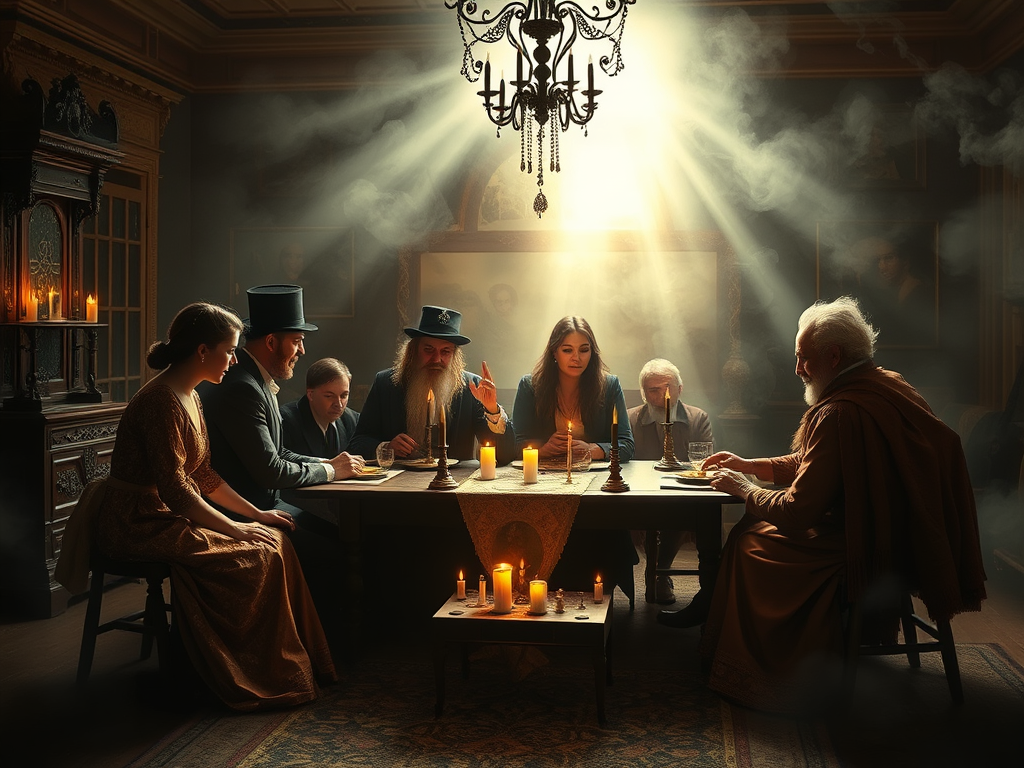
Now we move into the modern and esoteric interpretations (19th–21st centuries), where humanity’s view of “talking to the dead” shifted from religious prohibition to philosophical exploration, scientific experiment, and spiritual revival.
This period blends theology, mysticism, and even early psychology — the world trying to understand what lies beyond death while reconciling it with reason.
⚰️ 1. The Rise of Spiritualism (1800s)
🕯️ The Spark — The Fox Sisters (1848)
In upstate New York, Margaret and Kate Fox claimed to communicate with a ghost through “rapping sounds.”
Their fame spread rapidly, launching the Spiritualist Movement — a belief system that the dead could speak through mediums to guide the living.
Spiritualism became a fusion of:
- Christian vocabulary (“spirit world,” “heavenly spheres”)
- Occult practice (séances, spirit boards, trance channeling)
- Scientific curiosity (photography, magnetism, psychology)
At its peak, millions of Americans and Europeans practiced séance gatherings, believing contact with the dead was a natural continuation of Christian faith — not rebellion against it.
📜 Spiritualism’s Core Beliefs
- Souls survive death and dwell in progressive “spheres” of light.
- Communication between living and dead is possible through mediums.
- God and moral law still govern all spirits — there is no Hell, only evolution.
- The spirit world seeks to guide humanity toward enlightenment.
These ideas echoed fragments of Christianity, yet inverted its foundation:
Instead of waiting on divine will, mankind reached upward through will and technique — an act the Bible once labeled necromancy.
🔮 2. Theosophy and Esoteric Christianity (1875–1930s)
🜍 Helena Blavatsky and The Theosophical Society
Blavatsky’s writings (The Secret Doctrine, Isis Unveiled) merged:
- Hindu reincarnation
- Kabbalistic mysticism
- Christian Gnosticism
- Western occult traditions
She rejected necromancy in the old sense, but claimed contact with “Ascended Masters” — beings once human, now divine.
This reinterpreted necromancy as soul communion across spiritual planes, not summoning from Sheol.
“The dead do not return — but the living ascend.” — Blavatsky
Theosophy deeply influenced:
- Early psychology (Jung’s archetypes)
- Occult revival (Golden Dawn, Steiner)
- Modern “New Age” Christianity
🌠 3. Christian Spiritualism and the “Communion of Saints” Reimagined
Many Christians tried to reconcile these ideas with Scripture.
They proposed that the saints and departed faithful could consciously guide the living — not through séances, but through divine resonance.
Notable figures:
- Emanuel Swedenborg (18th c.): claimed to have walked the spirit world, guided by angels and deceased souls.
- Andrew Jackson Davis (19th c.): called himself “the Poughkeepsie Seer,” blending Bible verses with trance revelations.
- Rudolf Steiner (early 20th c.): taught that souls between incarnations work with angels for humanity’s progress.
They all sought to bridge Heaven and Earth without invoking demons — transforming “talking to the dead” into divine communion rather than forbidden magic.
🧠 4. The Psychological Reframing
In the 20th century, Carl Jung and William James reframed necromantic experience as psychological rather than supernatural.
- Jung: “The dead live in the unconscious, shaping the psyche through ancestral memory.”
- James: explored mediumship as part of the “varieties of religious experience.”
The “dead” became symbols of archetypal wisdom, trauma, or spiritual inheritance — an inner conversation rather than an external summoning.
Thus, what the Bible called forbidden contact became, in psychology, self-revelation.
☯️ 5. New Age and Modern Esotericism (1950s–Present)
By the mid-20th century, Spiritualism merged with Eastern mysticism, birthing the New Age movement, which teaches:
- All souls are energy, continuously evolving.
- The dead are not gone but transformed, reachable through meditation or vibration, not conjuration.
- Channeling replaces séance: mediums become “transmitters” for higher consciousness.
Modern examples include:
- Jane Roberts (the “Seth” material)
- Esther Hicks (Abraham teachings)
- Sylvia Browne, Edgar Cayce, and others who blended prophecy, psychic healing, and Christian themes.
Even Catholic mystics like Padre Pio (20th century) were said to see and converse with souls of Purgatory — reinforcing that, when God wills it, spirit contact can sanctify rather than corrupt.
✝️ 6. Modern Christian Doctrine: Distinctions Remain
Despite the popular resurgence of spiritual practices, official Christian theology still maintains strict lines:
| Type of Contact | Church View | Description |
|---|---|---|
| Prayer to Saints | Permitted | Communion through God, not summoning |
| Visions by Divine Will | Permitted | God-initiated, as in Scripture |
| Mediumship / Channeling | Forbidden | Invokes spirits by human will |
| Spiritualism / Necromancy | Forbidden | Risks demonic deception |
| Inner Communion / Meditation | Permitted (if Christ-centered) | Contemplative prayer, not conjuring |
The Church sees the spiritual world as alive but hierarchical — interaction must flow through God’s authority, not human ritual.
🕊️ 7. Philosophical Summary: The Continuum of Contact
| Era | Purpose | Who Initiates | Perceived Source |
|---|---|---|---|
| Ancient Israel | Seek knowledge or favor | Human | The dead (forbidden) |
| Early Church | Divine prophecy | God | Heaven / angels |
| Medieval | Salvation, guidance | God permits | Purgatory or saint |
| Renaissance | Knowledge / ascent | Human | Angels or “higher spirits” |
| Spiritualist | Comfort, proof of life | Medium | Departed souls |
| New Age | Self-realization | Channel | Cosmic consciousness |
Thus, humanity’s approach evolves — but the moral tension remains:
“Who speaks — and by whose authority?”
🔱 8. Thematic Reflection
If we step back, this journey — from Deuteronomy’s prohibition to New Age communion — tells a single story:
Humanity has never ceased to seek the voices beyond the veil.
The form changes — altar to séance, prayer to trance, flame to frequency —
but the yearning remains the same:
to know that death does not silence love.
Leave a Reply