
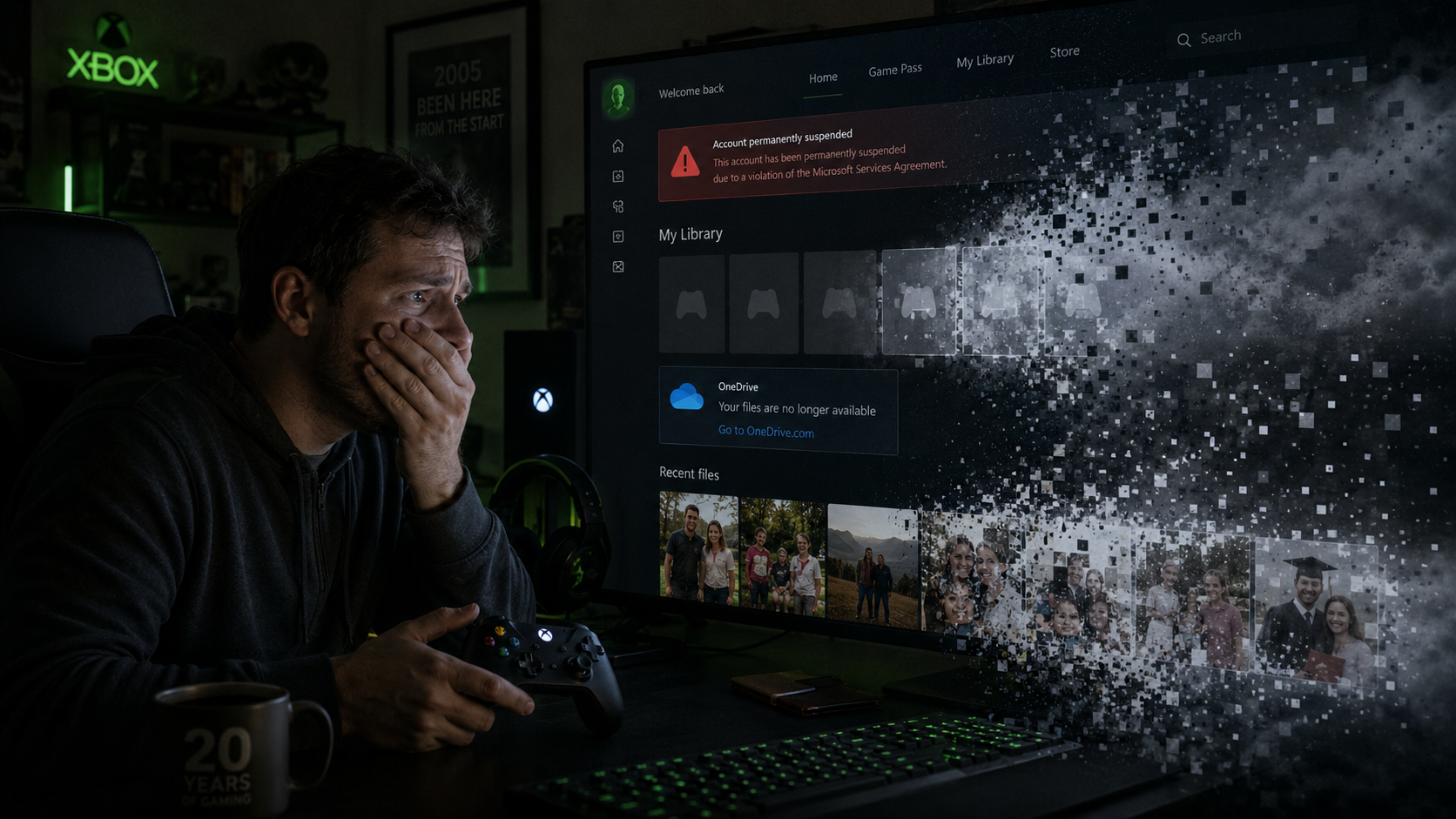
A longtime Xbox player says Microsoft deleted his 25-year-old account after it was compromised, allegedly wiping out thousands of euros’ worth of digital games as well as decades of personal files stored through Microsoft services.
Twitch streamer Joshua Kane shared the situation publicly on X after reportedly failing to get the account restored.
“Microsoft DELETED my account AND OneDrive!!?? After ACKNOWLEDGING that I’m the owner of the account and that it was compromised??? 25 f***ng years of data, thousands of euros spent on games?? My son’s baby pictures? GONE!” Kane wrote.
The claim has attracted attention not only because of the financial loss involved, but because it illustrates how much of a person’s digital life can become tied to a single online account.
More Than Just an Xbox Profile
For many players, an Xbox account is no longer simply a username used to play online. It can contain years of purchases, saved games, achievements, subscriptions, messages, contacts, and access to digital entertainment libraries.
When that same Microsoft account is also connected to OneDrive, Outlook, Windows, and other services, the consequences of losing access can extend far beyond gaming.
In Kane’s case, the deleted account reportedly contained more than two decades of personal information, including family photos, documents, and pictures of his son as a baby.
Digital games can sometimes be repurchased, although doing so may cost thousands of dollars. Irreplaceable family photographs and personal files are another matter entirely.
The Problem With Digital Ownership
The incident has reignited a familiar debate: Do consumers truly own the digital games they purchase?
When someone buys a physical game, they usually possess a disc or cartridge that can remain usable even if an online account is closed. A digital purchase works differently. In most cases, the customer receives a license connected to an account rather than permanent ownership of an independent copy.
That distinction may seem unimportant until an account is hacked, suspended, banned, or deleted.
Once access to the account disappears, the customer may also lose access to every game, downloadable expansion, movie, and subscription attached to it.
A library built over several console generations can vanish instantly, even though the user may have spent years and thousands of dollars building it.
Account Recovery Can Become a Second Crisis
Being hacked is already stressful. Victims must change passwords, review financial activity, secure email accounts, and determine what information may have been exposed.
The situation becomes even worse when an automated security or recovery system treats the legitimate owner as the threat.
Kane claims Microsoft acknowledged that he owned the compromised account before it was deleted. That allegation raises serious questions about how account-recovery decisions are made and whether permanent deletion should ever occur while an ownership dispute or hacking investigation remains unresolved.
Companies need strong security systems, but those systems must also account for false positives, identity theft, and compromised login information.
Deleting an account may stop an attacker from using it, but it can also permanently punish the victim.
One Account Can Hold an Entire Digital Life
Technology companies encourage users to keep everything within a single ecosystem.
One account may control gaming purchases, cloud storage, email, office documents, photographs, payment details, computer logins, and subscriptions. This is convenient when everything works correctly.
It is also a dangerous single point of failure.
A hacked password, mistaken security decision, or account deletion can affect nearly every part of a person’s digital life at once.
The reported loss of Kane’s son’s baby pictures is a painful reminder that cloud storage should not be treated as the only copy of important files.
Cloud services are useful, but they are not immune to account problems, company policies, technical failures, or unauthorized access.
Protecting Your Games and Personal Data
There is no perfect way to protect a digital game library because most purchases remain connected to the platform account. However, users can reduce the risk of losing personal files and account access.
Important photos and documents should be stored in more than one location. A reliable backup plan may include a local computer, an external hard drive, and a second cloud provider.
Two-factor authentication should also be enabled wherever possible, preferably through an authentication application or hardware security key rather than text messages alone.
Users should save purchase receipts, account recovery codes, console serial numbers, and other records that may help prove ownership during a dispute.
It is also wise to review account recovery information regularly. An outdated phone number or inaccessible backup email can make recovering a hacked account far more difficult.
Microsoft Needs to Provide Clear Answers
At the time of the claim, the public account of the incident came primarily from Kane’s statements. Microsoft’s full explanation, internal reasoning, and account-recovery records were not included in the original post.
That means the exact sequence of events still needs independent confirmation.
However, the broader concern remains valid regardless of the final outcome.
When companies control access to decades of purchases and personal information, customers deserve transparent appeal procedures, meaningful human support, and safeguards against irreversible deletion.
A 25-year-old account should not be treated as disposable. It may represent a person’s entertainment history, financial investment, relationships, memories, and family life.
The digital future promised convenience. Incidents like this show the hidden cost of that convenience: the things people believe they own may remain accessible only as long as a corporation allows their account to exist.
For digital consumers, the lesson is unsettling but increasingly clear.
Buying access is not always the same as owning something, and storing a memory online does not guarantee that it will remain there forever.
Leave a Reply