
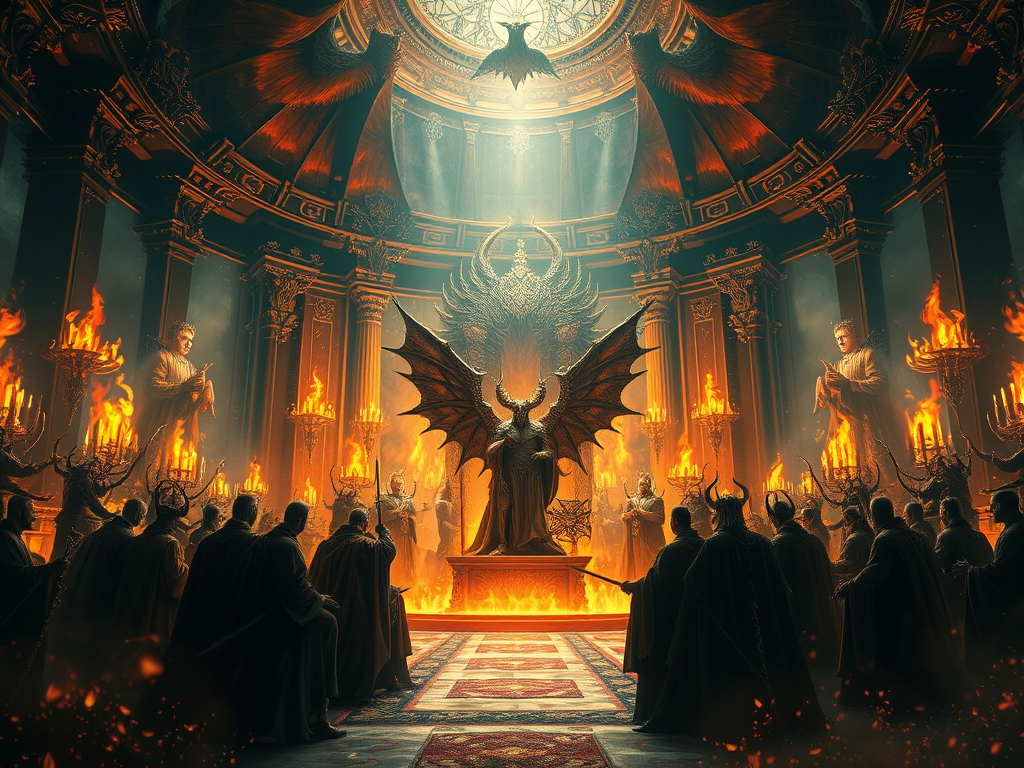
Milton’s infernal court unfurls like a parliament forged in volcanic glass, each throne carved from rebellion’s echo. He doesn’t divide Hell into nine circles the way Dante does; instead he builds a single vast, architectonic Realm of Perdition, with a capital (Pandæmonium) and a hierarchy of rulers among the fallen host.
Below is the roster of Hell’s powers according to John Milton’s Paradise Lost — the “Lords of the Burning Throne.”
Sovereign of Hell
Satan
Milton casts Satan as the towering architect of rebellion, a fallen archangel who becomes:
- King of Hell
- General of the rebel host
- Orator of Pandæmonium
His fire-wrapped charisma keeps the legions bound to him, even as despair gnaws through the armor of pride.
The Pandæmonium Council (the high princes of Hell)
These are the great powers who gather in the golden hall to debate the fate of their new kingdom.
1. Beelzebub
Satan’s closest confidant, “majestic though in ruin.”
His counsel is icy, measured, and politically lethal. Often viewed as Hell’s Prime Minister.
2. Moloch
A war-god of fire and brute resolve.
Advocates immediate, open war against Heaven. His aura seethes like a battlefield that never learned peace.
3. Belial
Beautiful, persuasive, morally hollow.
Preaches slothful luxury and avoidance of risk. His words spill like honey over a poisoned blade.
4. Mammon
Lord of wealth, obsessed with carving glory from the gold-veins of Hell itself.
He would rather reign over the infernal mines than ever bow again.
5. Ashtaroth / Astarte (rarely mentioned directly)
Milton glances at her in the catalogue of fallen angels; her domain is prideful desire and ancient rites. Often interpreted as one of Hell’s high nobles.
6. Chemos
Moabite god of corruption and unclean sacrifice.
In Milton’s vision, he wields a twisted priesthood among the damned.
7. Baalim & Ashtaroth (plural forms)
These represent the host of Canaanite deities-turned-fallen angels, part of Milton’s infernal aristocracy.
8. Dagon
The sea-giant; massive, tidal, and looming.
Later tradition makes him the watery lord of one of Hell’s coasts.
9. Rimmon
A storm-lord fallen from Syrian heights.
His thunder now rolls in the vaults above Pandæmonium.
Other notable fallen
- Mulciber: Architect who builds Pandæmonium itself, the infernal palace wrought in blazing metal.
- Thammuz: A spirit of dying-and-rising gods, now a melancholy figure among the fallen.
- Osiris / Isis / Orus / Anubis: Mentioned as ancient gods that became spirits or demons after the Fall; not rulers, but resonant figures in the abyssal tapestry.
How power actually works in Milton’s Hell
There is no nine-layered descent. Instead:
- Satan rules absolutely,
- Beelzebub is his chief lieutenant,
- and the rest form a kind of aristocratic cabinet of ruin.
The “circles” in the classical sense don’t exist. Instead, Milton imagines:
- A vast burning ocean of fire,
- The plain where Pandæmonium rises,
- The gates of Hell, guarded by Sin and Death,
- The bridge from Hell to the mortal world.
Think of it less as Dante’s descending funnel and more as a titanic continent under a blackened sky, its cities forged from fallen ambition.
Leave a Reply