
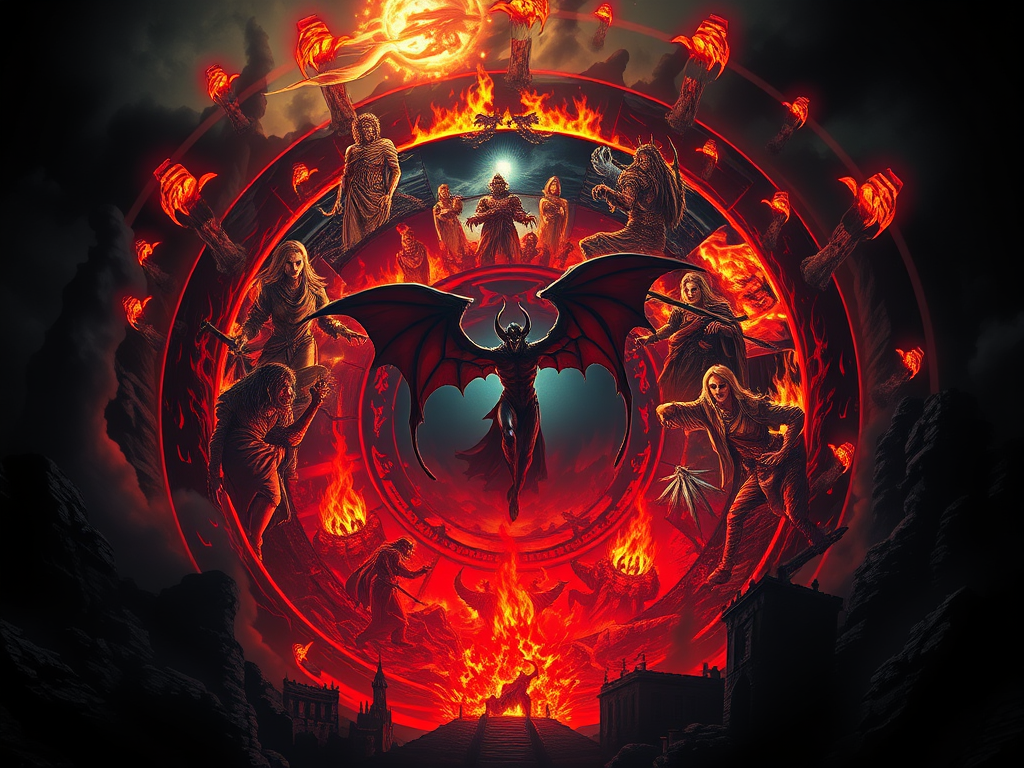
Dante’s Inferno presents Hell as a descending journey through forms of wrongdoing and their consequences. Its nine circles are part of a medieval poem, shaped by Christian theology, classical literature, and Dante’s judgments about the people and politics of his world. They should not be treated as a map supplied by the Bible.
Virgil guides Dante through much of the journey. The inhabitants include punished human beings, classical creatures, and figures serving particular narrative functions. A guardian, judge, ferryman, prisoner, and sovereign are different roles; the poem does not assign a demon king to each circle.
The Nine Circles: A Reading Guide
| Circle | Main wrongdoing or condition | Principal image of punishment | Cantos |
|---|---|---|---|
| 1: Limbo | The unbaptized and virtuous pagans in Dante’s scheme | Desire without the hope of seeing God; no ordinary bodily torment. | 4 |
| 2 | Lust | Souls driven in a relentless wind. | 5 |
| 3 | Gluttony | Filthy rain, mud, and the presence of Cerberus. | 6 |
| 4 | Avarice and prodigality | Opposing groups roll heavy weights and collide. | 7 |
| 5 | Wrath and sullenness | Conflict on the Styx and submerged anguish. | 7–8 |
| 6 | Heresy | Burning tombs within the city of Dis. | 9–11 |
| 7 | Violence | Three rings involving blood, a wood, and burning sand. | 12–17 |
| 8: Malebolge | Fraud | Ten ditches with distinct punishments. | 18–30 |
| 9: Cocytus | Treachery | Souls held in ice in differing positions. | 32–34 |
The vestibule before the circles, described in Canto 3, and the giants encountered near the descent to Cocytus in Canto 31 also belong to the route. They should not be inserted as extra circles or confused with the numbering above. Longfellow’s translation of Inferno provides the complete text.
Why the Punishments Fit the Sins
The principle often called contrapasso connects the punishment with the character of the wrongdoing, through resemblance, reversal, or exposure. The wind of the second circle, for example, makes uncontrolled movement part of the portrayal of desire. The images do interpretive work; they are not simply a sequence of increasingly elaborate tortures.
This does not mean every scene has one uncontested explanation. The poem invites attention to the souls’ own speeches and the narrator’s response. A sufferer’s moving account may evoke compassion while also revealing self-deception or an incomplete acknowledgment of responsibility.
Guardians Are Not All Rulers
Minos judges and assigns souls in Canto 5. Cerberus appears in the third circle. Phlegyas carries the travelers across the Styx. The Minotaur, centaurs, and harpies belong to different parts of the circle of violence. Their functions should be described individually.
Capaneus in Canto 14 is a punished blasphemer who remains defiant. He is not a ruler served by the other blasphemers. Geryon in Canto 17 is associated with fraud and carries the travelers downward; calling him the sovereign of all Malebolge goes beyond his role in the poem.
Asmodeus and Belial should not be added as rulers of Dante’s circles simply because they occur in other traditions. Familiarity from demonology does not make a name part of this literary structure.
Lucifer at the Bottom
The final image is strikingly different from a free and triumphant monarch on a throne. In Canto 34, Lucifer is immobilized in the ice. His vast presence displays degradation and captivity. The poem’s depiction undercuts the assumption that the deepest place in Hell must be a seat of effective independence.
This matters to the interpretation of the whole journey. Descending further does not reveal a rival creator equal to God. It reveals the end of rebellion in a condition marked by confinement and the destruction of right relationship.
What the Poem Can and Cannot Establish
Inferno is a primary source for Dante’s imagination and moral vision. It is not, by itself, proof that all Christians share every distinction in its geography. Its classical figures, contemporary people, political concerns, and theological judgments belong to the poem’s particular setting.
For Christian readers, a useful comparison asks where Dante draws on Scripture, where he uses inherited philosophical or literary ideas, and where his own poetic judgment shapes the scene. Those questions make the work richer without confusing literature with a universally binding doctrinal chart.
Primary reading: Dante, Inferno, Cantos 3–34, especially Canto 4 for Limbo, 11 for the explanatory structure, 14 for Capaneus, 17 for Geryon, and 34 for Lucifer.
Leave a Reply